Uploading your business knowledge — pricing, services, opening hours, FAQs
Voxinly is only as good as what it knows about your business. This is how to build a knowledge base that lets the chatbot answer almost everything customers ask, in your own voice.

The knowledge base is the single biggest lever you have over chat quality. A chatbot with a thin knowledge base waffles. A chatbot with a rich, specific knowledge base sounds like you wrote the answer yourself. The good news: it doesn't take long to build, and you can add to it whenever you remember something.
Where it lives
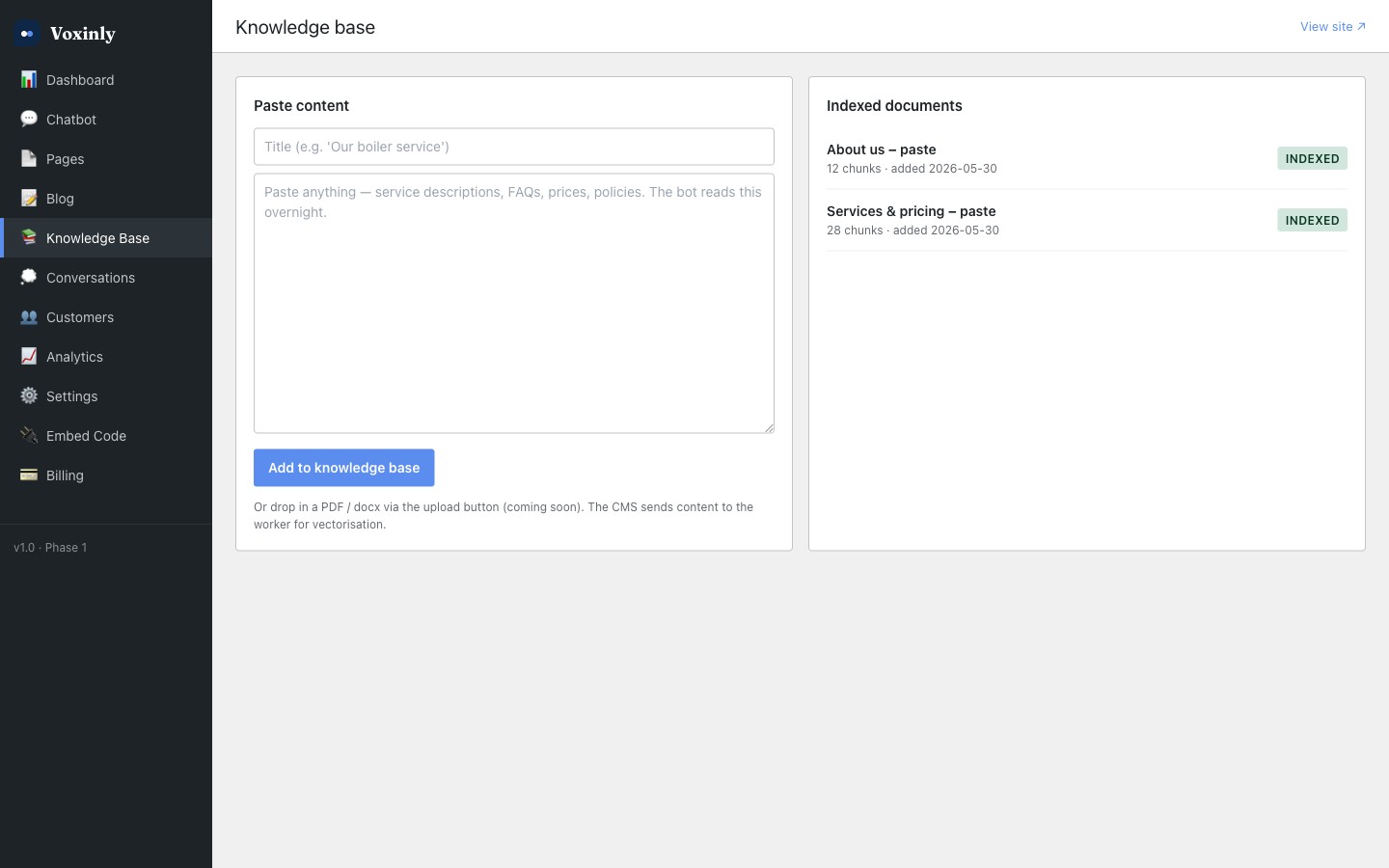
Click Knowledge in the sidebar at voxinly.com/admin. You'll see a list of every document you've added, plus a big 'Add document' button. Each document has a title and a body. Voxinly indexes everything overnight (usually within minutes) and uses it to answer customer questions.
What to put in
Think in six buckets:
1. What you do
Your trades and the specific jobs within them. A plumber isn't just 'plumbing' — they're 'boiler installs, boiler servicing, leak repair, kitchen and bathroom plumbing, emergency callouts'. Be specific. Customers ask about specifics. 'Do you fit Megaflo cylinders?' should have a yes-or-no answer in your knowledge base, not a generic 'we do plumbing' fallback.
2. Where you work
Postcodes, not vague 'South London'. List the outward codes you cover: SE1, SE5, SE15, SE22 and so on. If you take occasional jobs further out for a callout fee, say so. Voxinly will politely decline jobs outside your area, which saves you both time.
3. When you work
Opening hours, including emergency callouts. Weekend rates if different. Bank holiday policy. When you're closed (Christmas, summer break). Customers often ask 'can someone come today?' — Voxinly needs to know whether the answer is yes, tomorrow, or not until next week.
4. Prices
Ballpark numbers for the jobs you do most. Customers respect a number, even a range. Saying 'depends on the job, we'd need to come and see' is the right answer for complex work, but for a boiler service or a standard callout, a £ figure is much more useful. Be honest about variability — 'a standard boiler service is £85, complex jobs with parts can run to £150'.
5. How to book
Phone number, WhatsApp number, callback request, email. What you prefer. How quickly you reply. Whether you do site visits before quoting. This is the most converted-to-leads section — make it crystal clear.
6. What's an emergency
Define what you call an emergency callout vs a normal job. Define what your emergency-callout fee is. Tell Voxinly what an emergency *isn't* (e.g. 'a tap that's been dripping for a week is not an emergency'). This saves you 2am phone calls from people who can wait until morning.
How to format each document
- Keep each document focused on one topic — don't put everything in one giant doc
- Use plain English. No marketing fluff
- Use numbers and lists where you can — they're easier for Voxinly to extract
- Re-read it as if you were a brand-new customer. Does it answer what you'd ask?
Examples
Example 1 — boiler servicing
Example 2 — emergency callouts
Updating and pruning
Once a month, scan your Conversations tab and look for two things:
- Questions Voxinly couldn't answer well — add a knowledge document covering that topic
- Out-of-date answers (last year's prices, a service you no longer offer) — edit the original document and save